

Subscribe to receive our monthly newsletter featuring the latest company news, product highlights, and industry trends.
Core Technology Ⅰ
Controlled Release Fertilizer manufacturing
Production & Technology (R&D / Technology)
World-leading
World-leading
CRF (Controlled Release Fertilizer)
manufacturing technology
Maximizes fertilizer efficiency and labor savings by controlling the nutrient release period for each crop.
| Standard CRF | Feature | Nousbo Hi-COTE |
|---|---|---|
| Polymer-coated resin | Coating Source | In-house manufactured resin |
| Linear release only | Release Profiles | Linear & Sigmoid (patented) |
Annual Production Capacity
Ulsan Plant
20,000 t/yr
Two dedicated CRF production lines. ISO 9001-certified batch release.
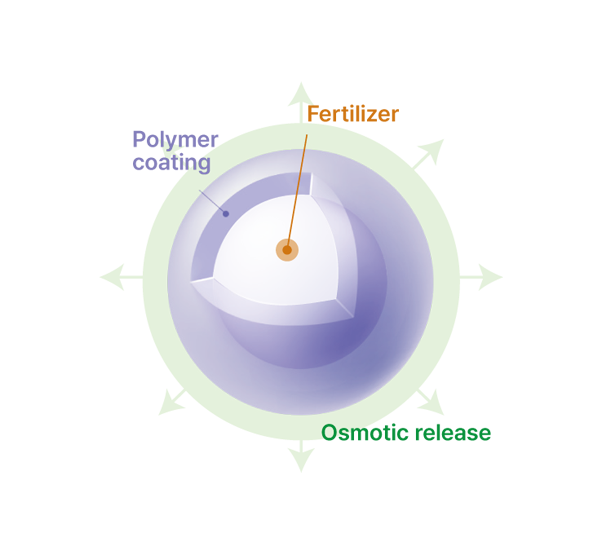
Polymer coating
Fertilizer
Osmotic release
Semi-permeable polymer membrane enables precise, temperature-driven nutrient diffusion
Manufacturing Process
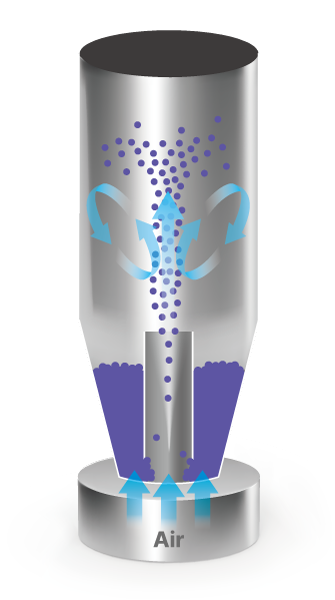
Fluid-Bed Coating (FBC) Technology: The Hi-COTE Manufacturing Process
Uniform encapsulation of granules in a continuous fluidized-bed chamber. Each granule receives an optimized polymer membrane, ensuring consistent nutrient release across the entire application window.
▲ Fluid-Bed Coating (FBC) process inside the chamber
01
Granule preparation & sizing
Raw fertilizer granules are sorted to a uniform particle size range. Consistent granule diameter is critical — it determines the surface-area-to-volume ratio, which governs membrane thickness profiles and the precision of release duration.
02
Fluidized-bed suspension
Granules are suspended in a temperature-controlled airstream within the FBC chamber, creating a uniformly tumbling particulate cloud. Every surface is exposed equally — a prerequisite for uniform coating adhesion.
03
Polymer coating application
Proprietary polymer solution (manufactured in-house) is atomized and sprayed onto the suspended granules. Coating builds in controlled layers. The formulation is adjusted by product SKU to achieve target release rates and durations — from 100 to 360 days
04
Thermal curing & membrane stabilization
Coated granules pass through a thermal curing zone. Controlled heat crosslinks the polymer membrane, stabilizing its semi-permeable structure. This stabilization step ensures the uniformity of release performance throughout the entire batch.
05
QC validation & ISO-certified batch release
Each batch undergoes accelerated release testing in environmental chambers. Nutrient elution data is compared against specification curves for the target release duration. ISO 9001-certified documentation is maintained for traceability.
Release Technology
Sigmoid-type release — synchronized with crop growth
Sigmoid-type coated fertilizer synchronizes with the S-shaped growth curve of crops, supplying nutrients precisely when needed, minimizing fertilizer loss, and preventing nutrient deficiencies.
Sigmoid Release Profile
Nousbo Hi-COTENutrient delivery accelerates during vegetative growth, peaks at high demand, then tapers as the crop matures. Minimal waste in early or late stages when uptake rates are low.
Linear Release Profile
Conventional CRFConstant release rate regardless of crop uptake demand. Nutrients applied in early stages leach before root systems establish. Late-season excess contributes to runoff and N₂O emissions.
Sigmoid-type coated fertilizer synchronizes with the S-shaped growth curve of crops, supplying nutrients precisely when needed, minimizing fertilizer loss, and preventing nutrient deficiencies.
Release Mechanism
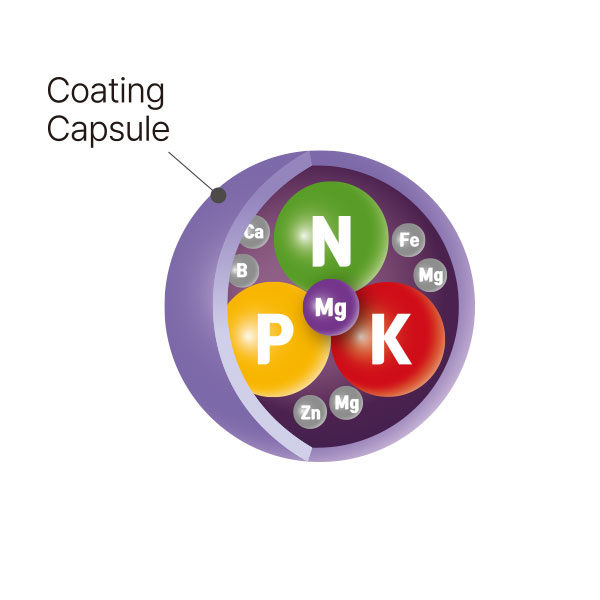
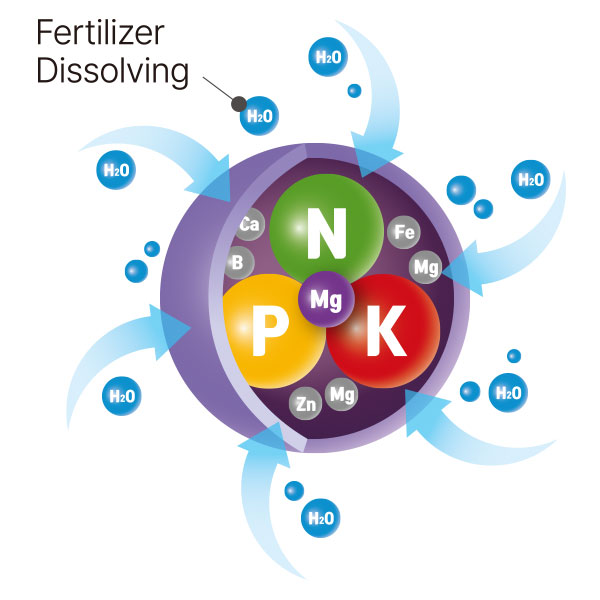
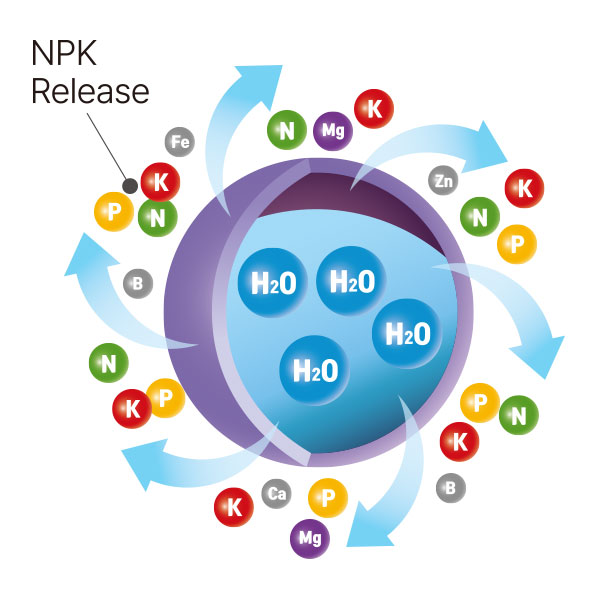
Three-stage osmotic release mechanism
Hi-COTE's nutrient release is entirely passive — driven by soil moisture and temperature without additional activation. Nutrients become available exactly when crops need them.
STEP 01
Moisture Penetration
Soil moisture permeates the semi-permeable polymer membrane through osmotic pressure gradient — entering the granule interior.
Trigger: soil moisture
STEP 02
Nutrient Dissolution
Water saturates the fertilizer core. NPK nutrients dissolve into concentrated solution inside the sealed membrane capsule.
Rate: temperature-governed
STEP 03
Controlled Release
Nutrients exit through the membrane at a rate dictated by osmotic pressure — precisely calibrated by membrane composition and thickness.
Duration: 100–360 days
Validated Performance Data
Measured impact vs. conventional fertilizer
Controlled field trials comparing Hi-COTE against standard granular fertilizers. Source: Nousbo Central Research Institute, 2024.
88%
Fertilizer usage reduction
vs. conventional granular
75%
Labor reduction
single-application protocol
67%
Greenhouse gas reduction
vs. conventional granular
89.7%
Non-point source pollution mitigation
vs. conventional granular
Nousbo vs. competitive CRF technology
| Feature | Nousbo Hi-COTE |
|---|---|
| Annual production capacity | 20,000 t/yr — Ulsan CRF Plant, Korea |
| Coating material | In-house manufactured polymer resin |
| Release profile options | Linear & Sigmoid (patented) |
| Release duration range | 100 – 360 days (SKU-specific) |
| Biodegradable option | Hi-COTE eco+ — PBAT/PBS resin, zero microplastic residue |
| Application protocol | Single pre-season application |
| Quality certifications | ISO 9001 · Korea High-Quality Fertilizer (2025) · OMRI Listed |
| R&D infrastructure | Dedicated Central Research Institute, Suwon HQ — RDA-designated since 2017 |
Next Generation
Hi-COTE eco+: Biodegradable polymer coating
Conventional polymer-coated CRFs contribute to microplastic accumulation in agricultural soils — a growing regulatory concern, particularly in the European Union. Hi-COTE ECO+ addresses this directly with a coating made from PBAT and PBS biodegradable resins.
After nutrient release is complete, the polymer shell is broken down by naturally occurring soil microorganisms. The coating degrades into CO₂ and H₂O — leaving no polymer residue. Designated as Korea's first government-certified "High-Quality Fertilizer" on August 14, 2025.

Soil Enhancement
NPS — Nousbo Plant Synergist
A proprietary functional bioactive compound combining biodegradable high-polymer materials, physiological metabolic activators, and organic acids. Extends fertilizer effect 2× and cuts application frequency to one-third.
Root Growth Promotion
Stimulates root mass expansion, increasing the effective nutrient absorption surface area and improving uptake efficiency throughout the crop cycle.
Stress Resistance
Improves plant tolerance to drought, heat, and salinity stress — reducing yield loss under adverse field conditions and climate variability.
Soil CEC Enhancement
Increases soil cation exchange capacity, reducing nutrient leaching and extending the effective window of applied fertilizer for longer crop availability.
Metabolism Activation
Activates the plant's basal metabolic pathways, improving photosynthetic efficiency and overall biomass accumulation for better yields.
2×
Fertilizer effect duration
⅓
Application frequency vs. conventional
3
Synergistic active components
NPS acts as a nutrient reservoir within the soil matrix — storing water and nutrients, then releasing them in response to plant physiological demand signals. Developed and exclusively owned by Nousbo.
Manufacturing Infrastructure
Global production & research network
From CRF production in Ulsan to field trials in the U.S. Midwest, Nousbo operates an integrated R&D and manufacturing platform spanning Korea and North America.
20,000
Tons CRF production volume (annual)
+20.9%
YoY growth rate
30+
Export countries across 6 continents
2025
Korea's first High-Quality Fertilizer designation
Central Research Institute — Suwon HQ
Dedicated R&D center for new product development, biodegradable polymer systems, and process innovation. RDA-designated Fertilizer Testing and Research Institute since 2017.
Nousbo USA — Houston, TX & Semmes, AL
North American subsidiary supporting Hi-COTE distribution, on-farm trials with UIUC, and OEM partnerships. Alabama warehouse for regional logistics. U.S. established 2018.
Quality & Compliance
Certified quality at every stage
Every Hi-COTE batch is produced under ISO 9001 quality management controls, with documentation covering raw materials, coating thickness, release curve validation, and final packaging.
ISO 9001 Quality Management
KOSDAQ Listed — 2022
Korea High-Quality Fertilizer — HI-COTE 23-5-12 (2025)
REACH Registration (EU — Coated Urea)
OMRI Listed Organic Products
RDA-Designated Fertilizer Testing Institute
Green Bio Company — Korea (2025)
INNOBIZ Technology Innovation Company
Ready to source high-performance CRF at scale?
Request technical data sheets, product samples, or OEM formulation discussions. Our export and technical teams respond within one business day.