

Subscribe to receive our monthly newsletter featuring the latest company news, product highlights, and industry trends.
Core Technology II
Biodegradable Resin Coating Technology
Precision-controlled nutrient release without the microplastic footprint. The next generation of sustainable CRF coating, designed for a zero-residue future.
Technology Overview
The Environmental Limitations of Conventional CRF Coatings
Standard controlled release fertilizers use polyethylene or polyurethane membranes to regulate nutrient release. These membranes are highly effective — but they are synthetic plastics that persist in soil for decades after degradation of the fertilizer core, accumulating as microplastic particles in agricultural land.
Nousbo's biodegradable resin coating closes this gap. By replacing petroleum-derived polymers with bio-based, microbially degradable membrane materials, the coating achieves the same release precision — controlled by membrane thickness and composition — while eliminating the residual plastic burden entirely. The coating breaks down via microbial activity in the soil, leaving no persistent residue.
First-to-market in Korea — Commercialized 2024
| Conventional Coating | VS | Nousbo Biodegradable |
|---|---|---|
| Polyethylene / Polyurethane | Coating Material | Biodegradable polymer resin |
| Persists 20–50 years | Soil Residue | Fully degraded |
| Microplastic accumulation | Long-term Impact | Zero microplastic |
| Regulatory risk (EU 2027+) | Compliance Status | EU-ready & OMRI listed |
| Linear only | Release Profiles | Linear & Sigmoid |
Degradation Mechanism
Three-stage biodegradation process
The biodegradable coating undergoes sequential breakdown through enzymatic, hydrolytic, and microbial degradation pathways — timed to complete well within a single crop cycle.
01
Nutrient Release Phase
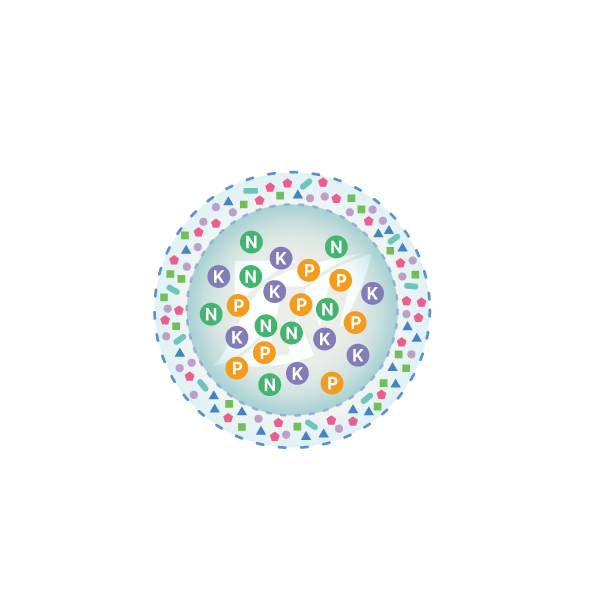
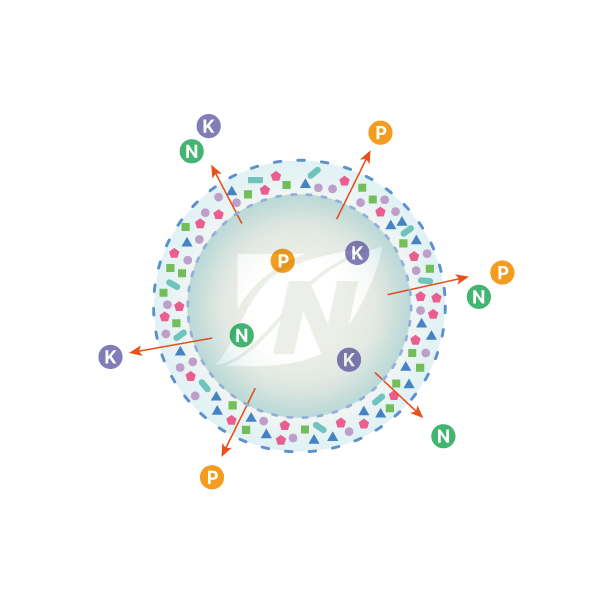
During the active release window (30–240 days), the coating functions identically to conventional CRF — soil moisture permeates the semi-permeable membrane, dissolves the fertilizer core, and nutrients exit at the controlled rate determined by membrane thickness.
Duration: 30–240 days
02
Enzymatic & Hydrolytic Initiation
Once the fertilizer core is fully depleted, soil enzymes and moisture initiate hydrolysis of the bio-based polymer chains. Ester and amide bonds in the resin backbone begin to cleave, fragmenting the membrane structure from the inside out. Temperature and pH affect reaction rate.
Trigger: core depletion + soil moisture
03
Microbial Mineralization
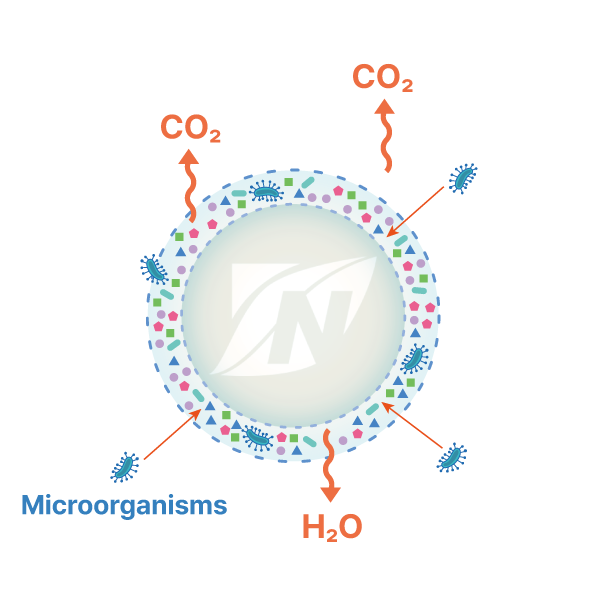
Fragmented polymer oligomers are assimilated by soil microbial communities as a carbon source. The result is complete conversion to CO₂, H₂O, and biomass — with no persistent microplastic particles remaining in the agricultural soil profile.
End result: CO₂ + H₂O (zero residue)
Degradation Timeline

From application to complete soil reintegration
Under standard soil conditions (25°C, field capacity moisture), biodegradable Hi-COTE coatings complete full mineralization within one growing season.
Stage 1
Active Nutrient Release
Membrane intact. Nutrients release via osmotic pressure at the designed rate. Coating function identical to conventional CRF.
Day 0–180
Stage 2
Hydrolytic Chain Cleavage
Polymer backbone begins to fragment as enzyme and water molecules attack ester bonds. Membrane becomes porous and structurally unstable.
Day 180–240
Stage 3
Microbial Assimilation
Oligomers are consumed by soil bacteria and fungi as a carbon source. Biomass, CO₂, and water are the only metabolic products.
Day 240–360
Complete
Zero Residue
Full mineralization confirmed. No detectable polymer fragments. Soil microbiome returned to baseline activity level.
Day 360+
Environmental Performance
Measurable environmental advantages
Switching from conventional to biodegradable CRF coatings delivers immediate and long-term environmental benefits, supporting farm ESG reporting requirements.
0
Microplastic Residue
After full degradation cycle
<12
Months to Full Mineralization
Under field conditions at 25°C
100%
Bio-based Carbon Content
In the membrane polymer fraction
Regulatory outlook: The European Union's Farm to Fork Strategy and forthcoming fertilizer regulation updates are expected to require microplastic-free certifications for polymer-coated fertilizers sold in EU markets by 2027. Nousbo's biodegradable coating technology positions distributors to meet these requirements without reformulating their product lines.
Regulatory Compliance
Certified for global market access
Nousbo's biodegradable coating products are developed in alignment with current and emerging global regulatory frameworks for sustainable fertilizer products.
🇪🇺
European Union
EU Fertilising Products Regulation (2019/1009)
Nousbo's biodegradable coating materials are being registered under EU FPR Component Material Category (CMC 12 / CMC 13) for polymer-coated fertilizers. Designed to comply with upcoming EU microplastic restrictions under REACH and ECHA guidance.
REACH Registration In Progress
🇺🇸
United States
OMRI Listed & State Registration
Biodegradable Hi-COTE formulations are OMRI listed for use in certified organic production under USDA NOP standards. State fertilizer registrations are maintained across all major US agricultural markets for compliant commercial distribution.
OMRI Listed
🇰🇷
Korea
Green Bio Company & High-Quality Fertilizer
First Korean manufacturer to achieve the Ministry of Agriculture's High-Quality Fertilizer designation for a biodegradable-coated CRF product. Recognized as a Green Bio Company by the Korea Bioindustry Association in 2025.
High-Quality Fertilizer Certified
🌏
Southeast Asia & Latin America
Market-Specific Registration Support
Nousbo provides complete product registration documentation packages for distributors entering new markets, including safety data sheets, biodegradation test reports, ecotoxicology data, and field performance summaries.
30+ Country Export Records
Ready to switch to microplastic-free CRF?
Request product samples, regulatory documentation, or discuss private-label supply of biodegradable Hi-COTE. Our team responds within one business day.